Ingra Eagle-Shield Iversdotter -- an Iversdotter Battlecrafter
Ingra is tall, with light blonde hair, Nordic features, and a muscular and buxom figure. She wears her hair in complex Viking-style braids, but with part of her head shaved in a kind of Viking-Punk look. She is in her late 20s or early 30s. She has a series of Norse runes tattooed across one cheek and down her neck. She has a lot of piercings, from ears to nose (not a bridge, please) to lip and perhaps further south. She wears a leather bustier and leather pants -- both sexy but practical-looking, perhaps patched. She has a long dagger on her hip, and one hand -- curled into a fist -- has nasty-looking bone spurs jutting from her knuckles, forming a kind of brass knuckle. Her expression tells the viewer to back the fuck off.
Picture after the jump
Showing posts with label ART. Show all posts
Showing posts with label ART. Show all posts
Friday, March 18, 2011
Tuesday, March 15, 2011
Kipman Archetypal Image and the Realm of Opening
Closk Hotblood -- a Kipman Soldier
Closk is a mongrel. He has features from half-a-dozen different animals. Primarily, he is human -- tall, heavy-set, imposing, a physique reminiscent of a bull or bear. He also features a bear’s muzzle and ram’s horns. His eyes are human, an intense blue. He is in his late 20s. He has patchy fur all over his body, interspersed with tan skin and the occasional patch of reptilian scales. One hand looks like a bear paw, while the other is human. He has the backward-jointed legs and hooves of a sheep. He is dressed in ragged clothes like that of a 19th-century peasant, heavily soiled and patched -- a coarse canvas shirt and ragged pants, with a jerkin of studded leather armor over it. In his human hand, he carries an old, heavily-notched hand axe. His face tells the viewer to die horribly.
See the picture after the jump:
Tuesday, March 8, 2011
Promethean Archetypal Image and the end of the Ma'ar
Phaedra -- a Promethean Explosives Artificer
Phaedra is tall and statuesque, with the high breasts and aquiline nose of a classical Greek statue. She is in her early 20s. Her skin is burnished a dull red, and her veins glow with a dim orange light. Her hair is cut in a “Cleopatra” hairdo, ash-gray, and her eyes look like glowing coals. She wears a flattering Greek tunic with bare legs. She holds a small black-powder grenade (like from Pirates of the Caribbean or old Looney Tunes cartoons), and is lighting the wick with a small breath of fire. She has a pyromaniac’s glee in her eyes. Image after the jump:
Phaedra is tall and statuesque, with the high breasts and aquiline nose of a classical Greek statue. She is in her early 20s. Her skin is burnished a dull red, and her veins glow with a dim orange light. Her hair is cut in a “Cleopatra” hairdo, ash-gray, and her eyes look like glowing coals. She wears a flattering Greek tunic with bare legs. She holds a small black-powder grenade (like from Pirates of the Caribbean or old Looney Tunes cartoons), and is lighting the wick with a small breath of fire. She has a pyromaniac’s glee in her eyes. Image after the jump:
Friday, March 4, 2011
Sky-Carver Archetypal Image and the Ma'ar continued
Tessiria Aderino -- a Sky-Carver Courtier
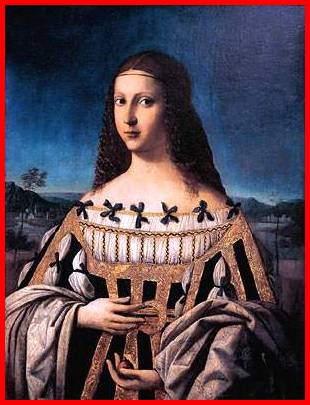
Tessiria is thin and tall, looking slender at best, if not emaciated. Her eyes have no irises, instead being a solid light blue, and her long hair, waving in an unseen breeze, is stark white. She is in her mid-40s. Her skin is pale and tinged with a light blue, with white, cloud-shaped markings appearing across her skin. She is dressed in a long, flowing Renaissance dress, perhaps inspired by Lucrezia Borgia’s dress in the attached picture. She should look sexy, supercilious, and terrifyingly cruel.

This is the only archetypal character we had Amy Clark draw that is an actual character in the playtesters' campaign. Specifically, this "Tessiria Aderino" is a Sky-Carver aristocrat collaborating with the Niontians to aid their invasion of the City of Lives, and is the primary antagonist of the campaign. The playtesters have only encountered her once -- and even then, only one character saw her personally (calmly torturing a servant who had failed her), but her fingers are in everything they see and touch, and are constantly acting to take down her numerous powers.
And
This
Picture
Is
HER!!!
Excellent work, Amy! Tessiria is ethereal, cruel, beautiful, and looks like she's floating despite being unable to see anything below her waist. Also, an excellent adaptation and interpretation of Lucrezia Borgia's dress in her famous portrait.
I can't really say negative, or even "constructive criticism" on this (besides the eternal "I wish it were in color," but that seems less necessary for this drawing than some others), so let's take a look at how the Sky-Carvers will change now that the Sons of Light are being removed from the game:
Very, very little. Mostly, the change will mean that they have fewer adversaries on the aristocratic battlefield, mostly fighting among themselves (and, to a lesser extent, the Leovites and Prometheans, but both of those bloodlines are less concerned with status than the Sky-Carvers and ex-Sons of Light). The only other change is that I'm removing the artistic temperament that formerly was a secondary part of the Sky-Carver personality, leaving Prometheans as the only artists -- because otherwise they step on each other's toes, archetypally speaking.
Let's take a look at the Ma'ar. We'll ARTT this out.
Archetype: First off, let's cover the fact that the Ma'ar and the Shertasi are designed to be, in the words of tvtropes.org, "Always Chaotic Evil." They are antagonists, first and foremost. The City of Lives is the hero of this campaign world, as it were. It may not be perfect, but a central thesis of the campaign world is that the City is the best of all possible Realms. Thus, the Shertasi Empire, the Niontians of the Lesser Chthonic Worlds, and Ma'ar Commonwealth are all antagonistic -- they may not be at war with the City itself, but their goals are almost certainly opposite to the PCs'. So while we want to create a realistic, full-featured society here, it's important to remember that it should be largely abhorrent.
Real-Life Inspiration: The Ma'ar are pack felines: how do we reconcile these two ideas? Well, let's start by listing out some attributes associates with dogs and wolves on one hand, and cats big and small on the other.
Dogs/Wolves:
Ritualized combat and dueling would play a large role in Ma'ar society, methinks - Every Ma'ar adult must own a very specially-designed, very expensive, very elaborate robe that is specifically meant for dueling and only dueling. They must always have this with them, prepared for a duel. In a duel, they will go through a very elaborate set-up, very ritualized, very formal, then let loose the savage beast within. They do not stop for a moment until one is dead. Then the winner must buy a replacement robe for the rags that he has just destroyed in his fight or he will have lost all the honor he just gained.
Okay, again we've run out of room. Next time, we'll examine the Promethean archetypal image, and look at the Ma'ar Theme and Twist. See you then!
Tessiria is thin and tall, looking slender at best, if not emaciated. Her eyes have no irises, instead being a solid light blue, and her long hair, waving in an unseen breeze, is stark white. She is in her mid-40s. Her skin is pale and tinged with a light blue, with white, cloud-shaped markings appearing across her skin. She is dressed in a long, flowing Renaissance dress, perhaps inspired by Lucrezia Borgia’s dress in the attached picture. She should look sexy, supercilious, and terrifyingly cruel.

This is the only archetypal character we had Amy Clark draw that is an actual character in the playtesters' campaign. Specifically, this "Tessiria Aderino" is a Sky-Carver aristocrat collaborating with the Niontians to aid their invasion of the City of Lives, and is the primary antagonist of the campaign. The playtesters have only encountered her once -- and even then, only one character saw her personally (calmly torturing a servant who had failed her), but her fingers are in everything they see and touch, and are constantly acting to take down her numerous powers.
And
This
Picture
Is
HER!!!
Excellent work, Amy! Tessiria is ethereal, cruel, beautiful, and looks like she's floating despite being unable to see anything below her waist. Also, an excellent adaptation and interpretation of Lucrezia Borgia's dress in her famous portrait.
I can't really say negative, or even "constructive criticism" on this (besides the eternal "I wish it were in color," but that seems less necessary for this drawing than some others), so let's take a look at how the Sky-Carvers will change now that the Sons of Light are being removed from the game:
Very, very little. Mostly, the change will mean that they have fewer adversaries on the aristocratic battlefield, mostly fighting among themselves (and, to a lesser extent, the Leovites and Prometheans, but both of those bloodlines are less concerned with status than the Sky-Carvers and ex-Sons of Light). The only other change is that I'm removing the artistic temperament that formerly was a secondary part of the Sky-Carver personality, leaving Prometheans as the only artists -- because otherwise they step on each other's toes, archetypally speaking.
Let's take a look at the Ma'ar. We'll ARTT this out.
Archetype: First off, let's cover the fact that the Ma'ar and the Shertasi are designed to be, in the words of tvtropes.org, "Always Chaotic Evil." They are antagonists, first and foremost. The City of Lives is the hero of this campaign world, as it were. It may not be perfect, but a central thesis of the campaign world is that the City is the best of all possible Realms. Thus, the Shertasi Empire, the Niontians of the Lesser Chthonic Worlds, and Ma'ar Commonwealth are all antagonistic -- they may not be at war with the City itself, but their goals are almost certainly opposite to the PCs'. So while we want to create a realistic, full-featured society here, it's important to remember that it should be largely abhorrent.
Real-Life Inspiration: The Ma'ar are pack felines: how do we reconcile these two ideas? Well, let's start by listing out some attributes associates with dogs and wolves on one hand, and cats big and small on the other.
Dogs/Wolves:
- Carnivores
- Hunters
- Pack mentality, complex hierarchy
- Strong
- Good sense of smell, hearing, decent sight.
- Mate for life, have "heat".
- Must be dominant to mate.
- Carnivores
- Hunters
- Independent
- Agile
- Good hearing, sight, decent smell.
- Have "heat", do not keep sexual partners.
- Must be dominant to mate
Ritualized combat and dueling would play a large role in Ma'ar society, methinks - Every Ma'ar adult must own a very specially-designed, very expensive, very elaborate robe that is specifically meant for dueling and only dueling. They must always have this with them, prepared for a duel. In a duel, they will go through a very elaborate set-up, very ritualized, very formal, then let loose the savage beast within. They do not stop for a moment until one is dead. Then the winner must buy a replacement robe for the rags that he has just destroyed in his fight or he will have lost all the honor he just gained.
Okay, again we've run out of room. Next time, we'll examine the Promethean archetypal image, and look at the Ma'ar Theme and Twist. See you then!
Tuesday, February 22, 2011
Realms - Niontia Unprime 236
We begin with a piece of concept art, for the Dead-Blooded bloodline, and then we will travel to Niontia Unprime 236.
Elexender Gwaiotus - a Dead-Blooded Blightshifter
Elexender is a dour, serious-looking young man in his early 20s. His skin is sallow and unhealthy-looking, his black eyes sunken. Part of his lip has rotted away, leaving his teeth visible. His straight black hair is cut into a style like the wigs of the Revolutionary War. He wears an 18th-century nobleman’s outfit -- waistcoat, breeches, cravat -- in stark, plain black, and it is old and not well-cared-for. He holds a skull in one hand, with the other hand making an arcane gesture at it. The skull appears to be regrowing its flesh. He stares at the skull with an intense look of concentration.
Elexender Gwaiotus - a Dead-Blooded Blightshifter
Elexender is a dour, serious-looking young man in his early 20s. His skin is sallow and unhealthy-looking, his black eyes sunken. Part of his lip has rotted away, leaving his teeth visible. His straight black hair is cut into a style like the wigs of the Revolutionary War. He wears an 18th-century nobleman’s outfit -- waistcoat, breeches, cravat -- in stark, plain black, and it is old and not well-cared-for. He holds a skull in one hand, with the other hand making an arcane gesture at it. The skull appears to be regrowing its flesh. He stares at the skull with an intense look of concentration.
And the image, after the jump:
Friday, February 18, 2011
On Archetypal Images and Realm Geography
As I've worked on this blog and my playtest campaign, I've realized two things: People want images, and I'm not very good at visual thinking. Hence, I decided that if I were to get across exactly what a "Rural" or "Grate-Scratcher" Iooked like, I would need some are. I wanted to get an "archetypal" image of each Bloodline, like those one might see in the Race descriptions in D&D or what have you, and also a bit of the Archetypes (similar to Classes in D&D or what have you). So I asked my fiancee to commission some art for me for Christmas. It turned out to be a Valentine's Day Gift, but whatever... For the next ten posts, we'll supplement the main topic with short discussion on the Bloodline pictures I got from artist Amy Clark (check her stuff out at deviant art). This is the the description I wrote for my fiancee, who sent it on to Amy:
Thewton Wells -- a Rural Explorer
Thewton is short and stocky -- perhaps five-foot-four and extremely thick -- but well-muscled. He is perhaps 30. His skin is a deep, deep tan -- though with Anglo-Saxon features -- and his hair, shaggy and mossy (see below), and eyes are both deep brown. His skin is caked in a half-inch of thick loam, with moss and small flowering plants sprouting all over his body -- if there’s a spot where his natural skin is showing, it’s singular and unusual. He wears a ragged pair of coveralls with neither shirt nor shoes, with a large backpack complete with a coil of rope, bedroll, and pickaxe. He has a confident, simple smile.
And here's the picture after the break:
Thewton Wells -- a Rural Explorer
Thewton is short and stocky -- perhaps five-foot-four and extremely thick -- but well-muscled. He is perhaps 30. His skin is a deep, deep tan -- though with Anglo-Saxon features -- and his hair, shaggy and mossy (see below), and eyes are both deep brown. His skin is caked in a half-inch of thick loam, with moss and small flowering plants sprouting all over his body -- if there’s a spot where his natural skin is showing, it’s singular and unusual. He wears a ragged pair of coveralls with neither shirt nor shoes, with a large backpack complete with a coil of rope, bedroll, and pickaxe. He has a confident, simple smile.
And here's the picture after the break:
Tuesday, February 8, 2011
Rural Communities

You stroll into town... or, at least, you think this is the town. A few old and battered store fronts line the single street, with houses dotting the landscape here and there, miles apart. An old Rural man nods at you from a rocking chair on the general store's porch, sod crumbling to the ground from his wrinkling forehead... Welcome to Bavingdon. Or is it Perstoke? Or Tursham? Or Hanwer-on-Wirth? Who can tell? All these small farming communities are basically the same, so they will all come together for this single post on Rural Communities.
Honestly, I really need to organize my ideas better. For months, I've been talking and writing about the three Rural communities that surround the City: Bavingdon, Perstoke, and Mestloath. Then, in preparation for today's post, I took a look at my map of the Realm of Lives, and saw that there was another, one Sathed, down in the southeast of the map, where I had apparently decided it was too large a blank region to be without a town. So. Yeah. What do I do? Do I trust my initial instinct, which was to have three towns -- or the me that put the map together, and add in a fourth one? Damn it, Past Me's, communicate with me better! Anyway, after a bit of cogitation, I decided two things: First, that Mapmaker-me was right, we need a fourth town, or that part of the map will be noticeably and bizarrely empty; and second, that Sathed is a terrible name. Combine that with the continual irritation I've had every time I have to use "Mestloath" [It sounds like meatloaf. What was I thinking?], I headed to my name generator.
For those who are interested, I use a marvelous random name generator for most of my "foreign language" names (as opposed to those that are based on real words, like Dead-Blooded or Sky-Carver). It's called The Everchanging Book of Names, and you can find it here. It randomizes results from lists of real names, deriving new names that "sound right" by using the same structure, letter combinations, and common prefixes/suffixes that occur in that culture. It's awesome, and the free demo version is remarkably powerful (I just registered it myself, so I'll report back in later on how much improved it is).
The EBoN gave me a mess of names to choose from in creating my two missing villages. Here are some of the better ones (the ones I considered using), derived from the "English Place Names" EBoNEBoN created for me just now: Uckmon, Searilsouth, Wastead-Frirnorth-Chirby, Brabourn, Chrintmere, Tostlam, Edgothfer, Hackbourne, and Cadgimpstone. When I looked at the original output, I noticed one that really appealed to me, except for one little bit: Hanwer-an-Math. Obviously based on the "Blank-on-blank" nomenclature convention that shows up in English place names, but with a different vowel in the middle. I could easily change it back to "on" and have a good name... but "math" is a word, and not one I want associated with the town -- these farmers can hardly count, much less higher mathematics. A while later, I ended up with "Wirth" and thought that would be a nice suffix to replace "math." The other one I almost went with... another "w" name that has vanished from my files, but decided I didn't want two "w" names, so decided Regitursham was cool, but too long and hard to pronounce... so I hacked off the first two syllables. Voila! Hanwer-on-Wirth and Tursham, the other two villages that, along with Bavingdon and Perstoke, will make up the Rurals' centers of "civilization." name library... Well, that's nice. I somehow deleted my castoffs. Okay, well, here are a few names
These four towns have a combined population of perhaps a few thousand people, and serve as small bastions of "civilization" in the rugged areas outside the City. I don't think they need a full ARTTBavingdon -- the most interesting, as it stands definitively within Crasher territory, and close to the border of Dead Tribes territory, so is always getting raided by one group or the other. Hence, it's a bit tougher than the other villages, and also holds the distinction of being the hometown of the only Rural rich enough to buy his way onto the City of Lives' High Council. treatment. However, I've established a little about
House Solfidley
Description: The home of the only Rural rich enough to buy his way into politics.
Threat: Solfidley intends to destroy the Council and its “corruption.”
Aspect: Secret Vendettas, Hated Wealth
Face: Arbron Solfidley — Rich Rural Revolutionary Working From Within
Description: The home of the only Rural rich enough to buy his way into politics.
Threat: Solfidley intends to destroy the Council and its “corruption.”
Aspect: Secret Vendettas, Hated Wealth
Face: Arbron Solfidley — Rich Rural Revolutionary Working From Within
This Arbron Solfidley has become a favorite NPC in the playtest game, where his "Southern Gentleman" persona, seen by the players as a mix between Colonel Sanders and Foghorn Leghorn, has earned him the nickname "Cockburn Fuckhorn." So... yeah.
Tomorrow we go off-Realm, as we begin examining the various universes that connect to the City of Lives. We'll begin with Niontia Unprime 236, one of the colonies of the 2-dimensional living shadows The Niontians. See you here!
Friday, February 4, 2011
The Heliotrope Cliffs
You step out of the carriage, smelling deeply the fresh mountain air. A tiny hamlet surround you -- a trading post to your left, a handful of ramshackle buildings to your right. You look up the winding path that leads to the mine entrance. Hearing a loud chanting behind you, you turn to see a mass of unionist protesters, waving signs and shouting in a variety of tongues... Welcome to The Heliotrope Cliffs. The center for mining for the City, and the Sons of Light's ancestral home, back when they were in full charge of the City.
Okay, so here's the history as it stands: Once upon a time, a group of humans lived by the Heliotrope Cliffs, and some of them migrated to the crux of rivers where the City of Lives now stands -- according to legend, guided by the hand of sun-god The Light. These City-builders and rulers of the government came to be known as the Sons of Light, led by the Monarch of Light. The original settlement at the Heliotrope Cliffs declined, as most of the Sons of Light migrated to the City over the next few centuries.
Then the Elder Trio came. From some Far Realm, these godlike beings removed the Monarch of Light from power [in a war? helping an internal coup? through unimaginably powerful magic? dunno yet], and the last remnants of the Heliotrope Cliffs population ended up in the City [how?], leaving it entirely abandoned.
Now, companies from the City mines iron, gold, the titular heliotrope, and other valuable minerals from the Cliffs, and archaeologists unearth the fascinating remnants of the ancient Son of Light culture.
Archetype: The Heliotrope Cliffs' main archetypal role is as a "collapsed civilization." The most classic examples of this archetype look like this: A grand old culture made the most amazing artifacts in the world/galaxy/universe, then vanished entirely -- Stargate's Ancients, Mass Effect's Protheans, Forgotten Realms' sarrukh, not to mention Atlantis. The Heliotrope Cliffs, however, is closer to the "collapse into barbarism" seen in Foundation, Red Dwarf, and the historical Roman Empire -- the people who once ruled are still around, in the form of the modern Sons of Light, but they are nowhere near as powerful as the old civilization.
Real-Life Inspiration: The inspiration here is every archaeological dig ever. The roads left behind by ancient Romans, the ruins of the Minoan civilization, the pyramids of south America... There are amazing things left behind by these people, art and culture and technologies forgotten until brought back up by the archeologists' careful hands. The old Sons of Light had Lightshaping techniques unknown to modern Crafters, as well as taking Blightshifting to a level now unknown [see the posts on the Blightbound and the Addix], so searching through their ruins always holds the promise of finding the City of Lives version of the Antikythera Mechanism.
Theme: The Heliotrope Cliffs are divided into two distinct areas (conceptually, if not physically): the mines, and the ruins. The mines represent oppression and hard times -- the workers are little more than slaves, and nobody has yet built a mine that's fully safe and easy to work in. On the other hand, the ruins represent lost knowledge, and the hope that it might one day be recovered.
Twist: Pretty easy one here, at least for me: The Sons of Light weren't nearly as amazing as everyone says they were. Personally, I am sick of the "good old days" mentality that goes with the "ancient civilization" trope, and believe that the present is the best we, as humanity, have ever had it. So the Sons of Light weren't so great -- their culture was oppressive and racist, sexist, and most other -ists you can thing of. And they may have created a few marvels that the modern City societies would find amazing, but for the most part, they would be considered amazing "for the time" -- like the Antikythera Mechanism or a third-grader's "A" paper, it's remarkable they made these things with the primitive knowledge they had at the time, but not in today's terms.
Now we leave the Heliotrope Cliffs for our final trip on our Realm of Lives journey, the trio of small farming communities that are the only towns of note outside the City: Bavingdon, Mestloath, and Perstoke. See you next time!
Tuesday, February 1, 2011
The Vulgar Morass
Your footing is unsteady, each step threatening to collapse into murky, stinking water. Vines droop overhead, and you have the uneasy feeling that they're hiding serpents in the trees. As you finally miss a step and begin sinking into the muck, you hear the whooping sound of angry natives... Welcome to The Vulgar Morass.
The Vulgar Morass -- this is probably the oldest name in The City of Lives. Originally, the Vulgar Morass was a geographical feature in a Tolkienesque D&D campaign I created in high school, called The Two Continents. Back then, it was a massive swamp where the goblins lives in a faux-American Indian tribal lifestyle. When I created the Realm of Lives. I saw a massive open space south of the City, and, as I've mentioned before, I want to keep the Realm of Lives small and manageable, so that adventures will explore the City and the other Realms. Hence, I looked through my old notes and plopped the Vulgar Morass down to block egress. So -- besides blocking people, what is the purpose of the Vulgar Morass?
I don't honestly know. I've focused my attentions on other areas -- so let's figure it out together.
Archetype: Well, the classical purpose of a swamp is similar to that of the forest -- wildness and the unknown -- but with a slightly different mood, including a certain "grossness." The swamps that come to my mind are: The Fire Swamp from The Princess Bride , filled with wall-to-wall danger -- and extremely original dangers like R.O.U.S.'s and Lightning Sand (or Snow Sand, depending on whether you're watching the movie or reading the book); the Swamps of Sadness from The Neverending Story
 , where sorrow is represented as slogging through mud that can swallow you whole if you let it; and, oddly enough, a TV movie adaptation of The Tempest that moves the action from an island to Mississipi, where the swamp represented isolation and nature at its wildest (the home of Caliban, for one).
, filled with wall-to-wall danger -- and extremely original dangers like R.O.U.S.'s and Lightning Sand (or Snow Sand, depending on whether you're watching the movie or reading the book); the Swamps of Sadness from The Neverending Story, where sorrow is represented as slogging through mud that can swallow you whole if you let it; and, oddly enough, a TV movie adaptation of The Tempest that moves the action from an island to Mississipi, where the swamp represented isolation and nature at its wildest (the home of Caliban, for one).Real-Life Inspiration: Well, here I'm really out of my depth. I have never once been near a swamp. All of my images of swamps come from the media -- and mostly fiction. I suppose I know ever-so-slightly more about the Everglades than any other famous swamp, having once seen a documentary about the plight of some endangered species or other, so let's call the Vulgar Morass based off of the Everglades... that's about it. Don't know much about the Everglades.
Theme: The Vulgar Morass's theme, methinks, is right there in the name: Vulgar. The swamp is gross. Uncivilized. Chaotic. So -- to really, properly be those things, somebody has to live there. It can't be just animals -- those are too natural and wild to be properly vulgar. So who lives there? Kipmen? No, those animal hybrids hold the Wilderwoods as their domain? Rurals? No the plant-men dominate the Julian Plains. Well -- what if a variation on the Grate-Scratchers live out here? The defining characteristics of the Grate-Scratchers are: 1) they live underground in the sewers -- and swamps are basically the countryside version of sewers; 2) their hygiene is so appalling it becomes an asset -- they can become caked in mud from the swamp as easily as the sewer system; and 3) they are tremendously resourceful, eking out a living from the scraps of the civilization above -- and they can show instead a Robinson Crusoe/Swiss Family Robinson ingenuity out in the wilderness.
In fact, this leads back to some additional:
Archetype: The "noble savage" tribesman archetype can be filled by the unnamed swamp-dwellers. The Noble Savage goes back centuries, and has shown up in such varied characters as Robinson Crusoe's Friday, Brave New World's John the Savage, and Dragonlance's Riverwind and Goldmoon. The noble savage is tribal, has natural knowledge, and has a simpler morality than the city folk. We've examined a partial example in the post on the Rurals' "Seeding Manual, but they hold to agrarian ideals and not pure nature.
Twist: First, we can revisit the idea that the noble savage is not necessarily morally superior or inferior to the city-dweller. Second -- perhaps the Vulgar Morass isn't so vulgar after all... perhaps a hidden civilization deep within the swamp has utilized the Grate-Scratchers' natural resourcefulness to make a sort of utopia. First question: Technological or magical? To differentiate it from the City, perhaps it should be technological (steampunk?). On the other hand, magic is much more efficient than gears and computer chips, according to City of Lives physics -- and technology doesn't work too well in mud and swampwater, anyway. So let's go magic. Second question: is this actually interesting? The hidden utopia is an old, classic concept that dates back literally hundreds if not thousands of years, at least back to the stories of El Dorado -- and the question is whether it's interesting, or has passed into cliche, or has passed back out of cliche into an archetypal concept. For this, I don't have an answer. Sound off in the comments!
Thanks for venturing into the disgusting swamps with me. Next time, we'll take a look at the City's main source of mineral wealth (and slave labor), the Heliotrope Cliffs.
Tuesday, January 25, 2011
The Addix
A tremendous, yellow-white pillar juts from the ground, reaching hundreds of feet above your head and arcing to meet a horizontal beam that stretches into the distance, supported by other, similar pillars. Slowly, it occurs to you that this strange structure is, in fact, a skeleton -- the last remains of a creature the size of a city. You gasp in awe and horror -- and are taken by surprise by the band of ravaging, raging zombies coming up from behind you...
Welcome to The Addix, home of the rage-filled undead raiders known as the Dead Tribes. The important features of the Addix are its inhabitants -- angry, vicious undead with no purpose but to cause pain to the living. The undead are known as the Blightbound (a constructed combination of the necromantic magic Blightshifting and the fact that the dead spirits are bound to their old bodies), and many are organized into said Dead Tribes.
The Dead Tribes originated in the first paragraph of the unfinished short story that started this whole City of Lives universe. I needed an origin for the "Dead-Blooded" who had undead heritage in their past -- and, sparkly vampires notwithstanding, I couldn't see people willingly mating with a corpse, so I invented "an army of ghouls, specters, and the run-of-the-mill dead" who had swept through the City and raped a significant portion of its populace. Later on, I gave these raiders the name "the Dead Tribes" -- and later still, I needed an origin for these tribes for my playtesters, as well as a generic term for the undead... hence Blightbound. Finally, they needed a place to live, so I stole a name and concept from an old, abandoned (and poorly-thought-out) fantasy campaign of mine based around lost technology mistaken for magic. This was the Addix -- a city-sized skeleton that provides infrastructure for a settlement beneath its arching spine. So... with the (extra-universal) origins of the Addix revealed, let's settle in for an ARTT treatment:
Archetype: If anyone in the shades-of-gray world of The City of Lives can be said to be pure, unadulterated evil, it is the Dead Tribes, and their home reflects that. Like Mordor, the Shadowlands, or All-World, the Addix is a blasted wasteland, showing the evil of its inhabitants in its very environment. In this case, it has a perfectly reasonable in-universe explanation: Being undead, the populace of the Addix have no need for food and have serious rage issues, resulting in their killing almost every plant and animal they can reach.


Real-Life Inspiration: The physical environs of the Addix have no particular inspiration in real life, but the Dead Tribes themselves definitely take their inspiration from terror groups such as Al-Qaeda or the IRA. They are based on exactly one thing: anger, and taking it out on others, and like terrorists, they hold this obsession over and above anything else. As every terror group, the Dead Tribes have a target they want to destroy -- in this case, the City of Lives -- but they take it a step further than most terrorists, in that the Dead Tribes' eventual goal is global extinction. As you will see in the Theme section below, the Dead Tribes envy the living, and want to take away what separates them (that being life, of course) -- and also want revenge on the necromancers who originally made them, but have expanded that desire for vengeance to apply to anyone alive. As such, they are organized like a terrorist army or cult, with the "compound" of the Addix as their whole world except when they venture out to cause mayhem.
Theme: One of the strongest and clearest themes The City of Lives, the Dead Tribes and the Addix are about people who have been hurt and who, instead of moving past the pain or turning it into altruism, choose to hurt others. It is about uncontrolled rage, obsession, and envy. You see, in creating the Blightbound's origin, I decided to make CoL's undead not mindless walking skeletons or ravening zombies, but the spirits of the dead, torn from their eternal rest and forced back into their rotting meat-suits, which causes them eternal physical and psychic pain. [My reason for this decision escapes me, except perhaps to justify their raiding nature I had already established, and to avoid stereotype (though, of course, this is not an entirely original idea: see Fire Sea and Buffy the Vampire Slayer
 's angst upon being resurrected for takes on this theme)]. Now, there are three ways to deal with pain and a loss of control: angst, acceptance, or anger. Unfortunately for the rest of the Realm of Lives, the Dead Tribes chose the latter.
and Buffy the Vampire Slayer's angst upon being resurrected for takes on this theme)]. Now, there are three ways to deal with pain and a loss of control: angst, acceptance, or anger. Unfortunately for the rest of the Realm of Lives, the Dead Tribes chose the latter.Twist: The biggest twist for such a place of evil is that... well, it's not. Not pure evil, anyway. Like everything in The City of Lives, there are shades of gray, with no such thing as "pure" good or evil. The Addix is filled with Blightbound who want nothing more than to extend their suffering, try to ameliorate their pain by inflicting it on others... but there are also a few undead and Dead-Blooded who have learned to deal with their tragedy, committing themselves to "living" good lives. Unencumbered by the need for food, sleep, or aging, these few enlightened souls can achieve remarkable things in the realms of art, science, magic, and philosophy -- or simply enjoy the company of others and the world around them. Though a rarity, these individuals are gems almost unparalleled.
Next time, we head back to the City... and straight past it, to take a look at the swampy Vulgar Morass that blocks travel to the southwest of the City. See you there!
Friday, January 21, 2011
The Mountains of Mourning
At the edge of the world, a mountain range looms. So high it scratches the sky (so they say), so inhospitable even the most powerful magics will not protect you (so they say), so long it cannot be crossed in a thousand lifetimes (so they say). These are The Mountains of Mourning, the northern edge of the livable region of The Realm of Lives.
Archetype: Mountain ranges have two purposes in fiction: hazardous routes to interfere with a journey or truly impassable barriers. Consider the mountain range "The Misty Mountains" in The Hobbit and Lord of the Rings -- it stands between the heroes and their destination, and they must travel with great difficulty through the mountains, exposing themselves to danger (and goblins). Then there are the impassable mountains -- common in video games as a way to justify limited map sizes (the Might & Magic series I played in my youth comes to mind). The Mountains of Mourning are designed more as the latter -- like the Wilderwoods, they are meant to be so difficult and dangerous to cross that nobody will bother, acting as the border to my campaign world.
Real-Life Inspiration: The physical inspiration is, I suppose, the mountain ranges in Washington and Alaska states, which I've been in (mostly driving through) many a time. Evergreens. Snow. Amazing vistas. More importantly, though, the remote, inaccessible spots in the Andes, the Himalayas, and such, are the model for the Mountains. Scaling the biggest peak (which is, of yet, nameless) should be just as monumental a task as climbing Mt. Everest.
Theme: Mountains are the classic spot for secrets and remote locations: Shangri-La , Shamballa, Nanda Parbat. So as well as being impassable, the Mountains of Mourning are filled with mysteries. A remote monastery or research institute (or both -- the Practical Theosophers may have a presence here); a military outpost from an invading crossRealm army; and local mythology holds that the demigod Prometheus is imprisoned in a cavern deep beneath the mountains. Secrets secrets secrets.
Twist: You know that absurd legend that the ancient demigod Prometheus, progenitor of the Promethean bloodline and son of The Light, is chained up in a cavern? He actually is! Okay, maybe that's not much of a twist for a fantasy campaign, in most of which all myths are true... but it is a hell of a campaign goal: Free the god-man who is either Jesus or Satan (depending on who you ask), and throw the entire world off-balance. I can see the splatbook now -- Prometheus Unbound... or is that title already taken?
Locations
Archetype: Mountain ranges have two purposes in fiction: hazardous routes to interfere with a journey or truly impassable barriers. Consider the mountain range "The Misty Mountains" in The Hobbit and Lord of the Rings -- it stands between the heroes and their destination, and they must travel with great difficulty through the mountains, exposing themselves to danger (and goblins). Then there are the impassable mountains -- common in video games as a way to justify limited map sizes (the Might & Magic series I played in my youth comes to mind). The Mountains of Mourning are designed more as the latter -- like the Wilderwoods, they are meant to be so difficult and dangerous to cross that nobody will bother, acting as the border to my campaign world.
Real-Life Inspiration: The physical inspiration is, I suppose, the mountain ranges in Washington and Alaska states, which I've been in (mostly driving through) many a time. Evergreens. Snow. Amazing vistas. More importantly, though, the remote, inaccessible spots in the Andes, the Himalayas, and such, are the model for the Mountains. Scaling the biggest peak (which is, of yet, nameless) should be just as monumental a task as climbing Mt. Everest.
Theme: Mountains are the classic spot for secrets and remote locations: Shangri-La
, Shamballa, Nanda Parbat. So as well as being impassable, the Mountains of Mourning are filled with mysteries. A remote monastery or research institute (or both -- the Practical Theosophers may have a presence here); a military outpost from an invading crossRealm army; and local mythology holds that the demigod Prometheus is imprisoned in a cavern deep beneath the mountains. Secrets secrets secrets.Twist: You know that absurd legend that the ancient demigod Prometheus, progenitor of the Promethean bloodline and son of The Light, is chained up in a cavern? He actually is! Okay, maybe that's not much of a twist for a fantasy campaign, in most of which all myths are true... but it is a hell of a campaign goal: Free the god-man who is either Jesus or Satan (depending on who you ask), and throw the entire world off-balance. I can see the splatbook now -- Prometheus Unbound... or is that title already taken?
Locations
The Worlds’ Cross
Description: Cross-Realm portal in which Prometheus is bound.
Theme/Threat (depending on your point of view): The Light’s rebellious son Prometheus is imprisoned here.
Aspect: A Prison That’s Also a Gateway
Faces:
Prometheus – Angry But Good-Hearted Demigod
The Eagle – Prometheus’s Sadistic Gaoler
Description: Cross-Realm portal in which Prometheus is bound.
Theme/Threat (depending on your point of view): The Light’s rebellious son Prometheus is imprisoned here.
Aspect: A Prison That’s Also a Gateway
Faces:
Prometheus – Angry But Good-Hearted Demigod
The Eagle – Prometheus’s Sadistic Gaoler
Niontian Outpost
Description: Small outpost of Niontians pondering invasion.
Threat: Niontians – lying, living shadows – scout force.
Aspect; Deceit Is a Way of Life For Them
Face: Vertex-of-Pain – Niontian Captain Intrigued by the “Truth-Tellers"
On our roundabout trip through the wildlands of the Realm of Lives, we will come back through The Addix, where angry undead raiders plot the City's destruction...
Description: Small outpost of Niontians pondering invasion.
Threat: Niontians – lying, living shadows – scout force.
Aspect; Deceit Is a Way of Life For Them
Face: Vertex-of-Pain – Niontian Captain Intrigued by the “Truth-Tellers"
2 comments
:
Labels:
ART
,
City of Lives
,
Locations
,
Mountains of Mourning
,
Realm of Lives
,
World


Tuesday, January 18, 2011
The Wilderwoods
You tread carefully along the narrow forest path, watching the mysterious shadows between the trees with mistrustful eyes. Something in the distance howls, the the howl breaks off into a squeal of pain... Welcome to The Wilderwoods. Last time we ventured out of the City for our first foray into the Realm of Lives and examined the safety and security of the Julian Plains. Now we head further, into the dark and mysterious forest that borders the Plains to the east. Known as the Wilderwoods, the forest marks the edge of the known Realm in that direction -- and it's filled with big nasties and adventures. Let's take a look.
Archetype: The big dark scary woods: The woods from Little Red Riding Hood , Mirkwood from The Hobbit
 , Sherwood Forest from Robin Hood
 . Dark, dangerous and unexplored -- filled with wild animals, both real and mythical. Perhaps bandits lurk in its depths, and they're more Mongol Hordes than Robin Hood. You never know what you're going to get in a forest like this -- hunting monsters, searching abandoned military outposts, encountering a rogue Crafter in a magical tower.
, Mirkwood from The Hobbit, Sherwood Forest from Robin Hood. Dark, dangerous and unexplored -- filled with wild animals, both real and mythical. Perhaps bandits lurk in its depths, and they're more Mongol Hordes than Robin Hood. You never know what you're going to get in a forest like this -- hunting monsters, searching abandoned military outposts, encountering a rogue Crafter in a magical tower.Real-Life Inspiration: Well, as a lifelong townie, I'm not terribly familiar with any forests in my own history. On the other hand, the evergreen forests of the Pacific Northwest have been on the periphery of my vision my whole life (not to mention in every TV show I watch that's filmed in Vancouver -- the immense number of evergreen forests on Stargate SG-1 's alien worlds comes to mind). So in my head, the Wilderwoods are mostly filled with pine and fir, with bears, moose, and cougars over tigers or crocodiles. Which, of course, reminds me of a question to answer at some point: what is the biome of the Realm of Lives like? Should it be like the Pacific Northwest, North American environment I'm familiar with? Should I rejigger it so that it more closely resembles the classic English countryside Tolkien made famous? Somewhere further afield, like Iran or Australia? Or does nobody care, and should I just jam together a fun, if environmentally impossible mish-mash of ecological characteristics? Sound off in the comments!
's alien worlds comes to mind). So in my head, the Wilderwoods are mostly filled with pine and fir, with bears, moose, and cougars over tigers or crocodiles. Which, of course, reminds me of a question to answer at some point: what is the biome of the Realm of Lives like? Should it be like the Pacific Northwest, North American environment I'm familiar with? Should I rejigger it so that it more closely resembles the classic English countryside Tolkien made famous? Somewhere further afield, like Iran or Australia? Or does nobody care, and should I just jam together a fun, if environmentally impossible mish-mash of ecological characteristics? Sound off in the comments!Theme: The Wilderwoods is, from a game standpoint, an adventure mill. It's a mysterious area filled with nasty critters. It's deliberately vague in terms of geography and inhabitants, so almost anything can happen there. In a more literary, thematic, sense, the Wilderwoods represents the wild unknown. The mysterious, shadowy, "here there be monsters" part of the map. The Wilderwoods should never be a safe haven for the PCs, but a place for adventure and terror.
Twist: Well, for once, here's a dark and mysterious forest that's not secretly populated by elves and fairies, so that's new... seriously, I got nothin'. The Wilderwoods are dark and mysterious. They represent the edge of the world -- and also the edge of my interest. The City of Lives is about the titular City, and about the other Realms the characters can explore. While I like the places I've built up around the City, they are not where my design goals fall -- this is not really a dungeoneering or frontiersman campaign -- so I don't have all that much in my head to fill the mysterious void of the Wilderwoods with. And maybe that's okay. The whole point of them is to be mysterious, after all, ready to be populated with whatever the GM needs that day...
Locations:
The Greensman’s Garden
Description: On the edge of the woods, a perfectly-maintained garden sits, maintained by a mysterious... Rural? Demigod?
Theme: A forest guardian keeps his garden safe.
Aspect: A Demigod of Dubious Divinity Dwells Here
Face: The Greensman – Eccentric Rural or God of the Wild?
The Greensman
Character Concept Aspect: ’Umble ’Elper of the Wilderness
Bloodline: Rural Turned God – Or The Other Way ’Round
Youth: Follows the Seeding Manual to the Letter – Maybe He Wrote It?
First Adventure: Oi Must Protect Me Garden
Free-Form 1: Very Gullible and None Too Bright
Free-Form 2: Moi Friends Morris
The Crashers’ Camp
Description: Home of the Crashers, a Kipman/Rural band of barbarian raiders
Threat: Home of paranoid, angry marauders
Aspect: They Can Be Fun When They're Not Murdering You
Face: Skarch – Kipman Barbarian Leader Working on His Anger Issues
Next time we'll venture to the very edge of the known Realm of Lives (at least to the East) in the Mountains of Mourning. See you there.
Thursday, January 13, 2011
A Newbie's Primer -- and The Julian Plains
Welcome back. We've spent the last few posts on mechanics with the Universal Conflict System, but this blog is mostly about setting, so now we're going to head back to the City of Lives. I imagine we have a lot of newbies here, after Mike Olson and Johnn Four's kind words on their blogs. Hence, before we jump back into the campaign world of The City of Lives, I'll give a brief rundown of the setting as we've explored so far:
- The world is a cross-dimensional high fantasy setting centered around the devious political maneuvering and class warfare of the titular City of Lives.
- The City is at a pre-industrial revolution, vaguely 18th-century level of technology -- but most of its industry is based around its particular form of magic known as Crafting.
- Though creatures from many, many world (known as Realms) inhabit the City, it is dominated by ten Bloodlines. Each of these Bloodlines are essentially human, but have heritage from a variety of sources, from animals to magical clones to the undead.
- The City of Lives is at the center of a crossroad of realities, but, more mundanely, also sits at the confluence of two rivers, on the fertile Julian Plains.
Our first extended series from Sylvennis to The Lost District was on the City's districts. This time, we're going to head outside the city into the Realm of Lives and its wilderness. The key landmarks we're going to look at and ARTT out include:
- The Julian Plains
- Bavingdon
- Mestloath
- Perstoke
- The Wilderwoods
- The Addix
- The Vulgar Morass
- The Mountains of Mourning
- The Heliotrope Cliffs
Let's begin with the most important piece of support for the City: the agricultural community that is the Julian Plains. This is where the City gets its food and trade goods, the support of the massive entity that is the City.
Archetype: The small farming communities beset by bandits and marauding monsters is a staple of the fantasy genre, and this is where the Julian Plains fit in. A place for PCs to call home, a safe place but also a place of constant adventure. Tristram, the Shire, West Harbor -- these are the inspirations for the locales of the Julian Plains.

Real-Life Inspiration: The Julian Plains are, in my mind, based heavily on the rolling hills of the Palouse (eastern Washington state), where I grew up. You may know the image -- it was the default desktop background image for Windows XP. Wheat and barley cover low hills, with the occasional sheep, horse, or cattle ranch dotting the landscape. The populace is made up of simple farmers, uninterested in higher education, complex art, or politics.
Theme: Both practically and thematically, the Julian Plains are the support structure for the City. The City relies on grain and meat from the Plains in order to survive. The Plains provide the City with necessities both directly and indirectly, as the City trades the Plains' goods to other Realms. The Julian Plains also rely on the City -- for protection and government, [more here]. Like every infrastructure, literal and metaphorical, the Plains are solid, dependable, and unremarkable. They have no need for fancy art or complicated magic -- but without the Plains, the City would be unable to have these things.
Twist: The seemingly idyllic Plains have got to hide a secret -- but what kind? Perhaps an underground revolution is slowly coming to boil as some of the Rural peasants wonder what they really get out of their association with the City, and want to gain their independence. Revolutionaries have always turned their farming implements into weapons of war -- and since the farmers on the Plains use magic to control animals and plants directly... well, I'm scared.
Locations
Wells Ranch
Description: A small homestead outside of Bavingdon, constantly attacked by bandits.
Theme: Stability threatened by chaotic forces
Aspect: Peaceful Plantation Beset By Bandits
Face: Plenton Wells -- Desperate and Paranoid Cowboy Protecting His Property
Brintall Dam
Description: A dam blocking off a small tributary of the River Actetas. It creates Brintall Lake.
Threat: Local Crasher raiders are targeting the dam for destruction, threatening the nearby farms.
Aspect: You'll Need More Than a Finger to Plug This Dike
Face(s): Brakk -- Kipman Raider Itching To Cause Some Chaos
Orton -- Rural community Leader With His Head in the Sand
Passel Mill
Description: A small mill that provides grain to the local community.
Threat: The owner smuggles herbal drugs to the City
Aspect: Simple Beauty Hides A Filthy Underside
Face: Dowen -- Miller With a Terrible Secret
All right. Come back next time to take a look at the dark, mysterious Wilderwoods...
All right. Come back next time to take a look at the dark, mysterious Wilderwoods...
Tuesday, December 28, 2010
Religion -- Kivian Taoism
Today is a day unlike any other before: you shall see me create a concept from whole cloth. As covered previously, I created a religion called Kivian Taoism, by throwing together an established religion with a nonsense word. But I never developed it: in my notes, I have this: "A religion common in many other Realms but uncommon in the City, that emphasizes a relaxed view of the world." So we're going to ARTT this baby out, starting from nothing, and in real-time. And because we've got a Real-Life Inspiration but nothing else, it'll actually be RATT today. A coincidence..? Probably.
Real-Life Inspiration: Well, obviously, the main inspiration here is going to be Taoism. Unfortunately, most of my knowledge of Taoism comes from a half-remembered section of history class, supplemented by Taoism as represented in Hollywood and some skimming of Wikipedia articles. On the plus side, the influence of the Kivians means that the religion doesn't have to share much with Taoism beyond a few basic tenets, which I believe I understand. That said, the core concept of Taoism is understanding and following the "tao" -- or "path/way/doctrine/etc." -- that is the "flow of the universe." True adherents try to practice "wu wei" ("without action"), trying to "go with the flow" and keeping their ego out of the way of their lives. I suspect Taoism was a major influence on Star Wars' "Force." With these fundamental tenets in mind, this leads to a common...
In our Theme, perhaps we will find exactly what makes Kivian Taoism distinct. The City's primary religion, The Church of the Blinding Light, makes ambition a virtue and focuses on combining secular and religion power. The Rurals out on the Julian Plains have a simple and straightforward religion focused on the metaphor of farming and the importance of roles. The Iversdotter Revelation focuses around the gang and supporting each other. A commonality in all of these religions is a focus on a community -- even the ambitious Sons of Light are supposed to elevate their entire bloodline instead of merely oneself. So we see a gap, do we not? A religion focused on the individual, on the self, ignoring what others might do, want, or need. So let us say that the Kivians are a species who live in nearly complete isolation, coming together only to breed -- and so they developed a philosophy of self above all. This is, after all, still Taoism, so it will not be ego above all -- the believers still believe that the universe has a flow and following it without effort is the "way" -- but the way has no room for other people in it.
Twist: Well, I see a logical consequence of our theme that twists the basic Taoism conceits a bit: a Kivian Taoist would not hesitate to use force or violence, should something get in the way of their own personal "tao." Some might take up the religion as a way to justify a heartless life, crushing everything in the way of their goals -- but I think that would be a perversion of the proper concept, because it is based on ego, which should be removed from action in proper Kivian Taoism. How exactly a believer decides what is part of their "way" and should be allowed, and what is attempting to pull them from their "way" and should be eliminated, is a question I don't have an answer to, that I'm sure has been a point of contention in Kivian doctrine for centuries...
Next time, we will step away from religion -- and from worldbuilding -- for a bit, and take a look at the Universal Conflict system I'm trying to cobble together, to allow players in The City of Lives to run anything from a dialogue to surgery using the same rules as combat.
Real-Life Inspiration: Well, obviously, the main inspiration here is going to be Taoism. Unfortunately, most of my knowledge of Taoism comes from a half-remembered section of history class, supplemented by Taoism as represented in Hollywood and some skimming of Wikipedia articles. On the plus side, the influence of the Kivians means that the religion doesn't have to share much with Taoism beyond a few basic tenets, which I believe I understand. That said, the core concept of Taoism is understanding and following the "tao" -- or "path/way/doctrine/etc." -- that is the "flow of the universe." True adherents try to practice "wu wei" ("without action"), trying to "go with the flow" and keeping their ego out of the way of their lives. I suspect Taoism was a major influence on Star Wars' "Force." With these fundamental tenets in mind, this leads to a common...
Archetype: The wise man who lets life pass by without influencing it or being influenced by it -- often a hermit and/or from a vaguely Asian culture -- is an old fantasy standard. Obi-Wan Kenobi, Lu-Tze of Discworld, Master Oogway of Kung Fu Panda -- these are just a small handful of examples. And then we've also got the characters of the Dude in The Big Lebowski and Dex of The Tao of Steve, modern-day reinterpretations of the "laid-back" nature a true Taoist should have. A Kivian Taoist will certainly fit these molds: unflappable, unconcerned with politics and strife, either incapable of handling the stresses of City life or simply not wanting to.
Twist: Well, I see a logical consequence of our theme that twists the basic Taoism conceits a bit: a Kivian Taoist would not hesitate to use force or violence, should something get in the way of their own personal "tao." Some might take up the religion as a way to justify a heartless life, crushing everything in the way of their goals -- but I think that would be a perversion of the proper concept, because it is based on ego, which should be removed from action in proper Kivian Taoism. How exactly a believer decides what is part of their "way" and should be allowed, and what is attempting to pull them from their "way" and should be eliminated, is a question I don't have an answer to, that I'm sure has been a point of contention in Kivian doctrine for centuries...
Next time, we will step away from religion -- and from worldbuilding -- for a bit, and take a look at the Universal Conflict system I'm trying to cobble together, to allow players in The City of Lives to run anything from a dialogue to surgery using the same rules as combat.
Thursday, December 23, 2010
Religion - Practical Theosophy
The notion of “practical theosophy” came about, simply, from a need for some religions and playing with words. I needed some minor religions other than the Light, just to add verisimilitude. I started by taking “name of real religion” and adding an adjective to the beginning, trying to imply that these religions were variants or offshoots of the faiths we are familiar with, emphasizing the nature of The City of Lives as a multiversal setting. The two I kept around were Kivian Taoism and Practical Theosophy. When I put together the words “practical” and “theosophy,” they were random -- I didn’t even remember what theosophy was. At the time, just that it was an obscure religion. Then I went back and researched it, in preparation for this article and incorporating it into my playtesting -- and discovered just how appropriate it was. You see, Theosophy was a strange, semi-religious movement back in the late 19th and early 20th centuries. Its stated goal was the synthesis of religion with science, attempting to understand God (“Theo” in the Greek) through knowledge or study (“logos” or “logy”). Their attempts to understand the supernatural world utilized new scientific advances that are either mundane, discredited, or now associated with the New Age movement -- meditation, hypnosis, astral projection. However, due to our own limitations, their “studies” of the religious sphere were inconclusive and not widely accepted. However… what if they were able to prove the existence of gods, and interact with them directly?
Hence, “Practical” theosophy must be like “applied physics”: a methodology for practical research on the nature of divinity and religion. As we have explored the nature of both divinity and their general understanding before, I will not reiterate, except to say that the people of the City may know that gods exist, but they do not know much more about their nature than we do about divinity in the real world. The practical theosophers wish to change that. They are philosophers, both in the modern sense of the word and in the City’s meaning of “scientist.” But there is an element of faith in all great endeavors, and practical theosophy is no exception.
Archetype: Well, this is a tough one. My first impulse is to say the gnomes of Krynn, Ponder Stibbons of Unseen University, and other pseudo-scientists in fantasy literature. But the thing is -- these are few and far between, and are all directly drawn from real-world scientists (or, at least, satire of such). So what's a more interesting route to take? Well, though their methods are scientific, the goals of the theosophers are fairly hardcore religious in nature: who are the Gods? So let's base their archetype off of the "fanatical cult" model: Theosophers are devoted to finding knowledge above all other concerns, whether ordinary concerns like food and family or ethical concerns like not decimating the Kipman population as unwilling test subjects. The "ends justify the means" mindset that typifies cults is very similar to how scientists are portrayed in much media, after all...
Real-Life Inspiration: The main real-life inspiration here is from experimental scientists -- those on the edge of a new field, whether electrical engineers a century ago, roboticists today, or -- appropriately -- parapsychologists. The theosophers believe they can find an answer -- the answer -- through careful tests and rigorous experimentation… but they don’t know what they’re doing. Their understanding of the field is so limited, the field itself so vast, that they are almost grasping in the dark.
Theme: The theme here is two-edged -- it is both “noble exploration” and “things man was not meant to know.” The gods are mysterious and need to be understood -- but they are also mysterious, complex, and dangerous. Trying to study miracles -- as infrequent and unexpected as they are in the City -- is nearly impossible to do with any rate of success, let alone repeatability. On the other hand, trying to persuade a god to come into the laboratory for some tests, to submit to questioning -- these are requests likely to one’s ass smote.
Twist: Let's have a good, secret-to-build-a-campaign-around twist here. Let's say that while most of the theosophers are genuinely trying to discover, for good and for true, what's going on with the gods -- but that the entire movement was started by a small-time god who didn't want the world to know that he is a physical being (albeit one from the Far Realms). Imagine if Flynn of Tron hadn't admitted that the Users were imperfect, but had instead started a cargo cult worshiping and dedicated to studying Users... while simultaneously feeding them bad data and constantly leading them down the wrong path. Should this trickster deity be exposed, what will happen? Would practical theosophy shut down completely, or would they regroup, now knowing what missteps to avoid? An interesting question...
Next time, we tread into completely unexplored territory with Kivian Taoism!
Tuesday, December 21, 2010
Religion -- The Iversdotter Revelation
Welcome back, and welcome to the next religion on our list, the Iversdotter Revelation. The Iversdotters are the City of Lives' resident "Proud Warrior Race," and were, early in my thinking, going to be mostly worshipers of the Light. Then I thought about it, and something struck me as wrong -- this is a race of clones, essentially, and descendants of a woman so enamored of her own form that she made a whole race of herself. Logically, a form of very specific ancestor worship would arise in the Iversdotter community -- honoring the original Iver as a deity, or at least intercessory to the divine. In fact, perhaps that's it -- the Iversdotter Revelation/Iversdotter Heresy is to the Church of the Blinding Light as Christianity is to Judaism: they worship the same God, but see a particular individual as the only true path to that God. There you go, gentle readers -- a genuine idea formed and radical shift in how I look at the Iversdotter religion, that came to me as I wrote those words. Can't get much more into a writer's head, can you?
But I digress. With our new revelation in mind, let's ARTT this out.
Archetype: The model here is the pseudo-religious "warrior's code" seen in countless fantasy and sci-fi worlds -- Star Trek 's Klingons, Stargate SG-1's Jaffa, The Lord of the Rings' Rohirrim. Whatever else the Iversdotter Revelation may be, it is the set of guiding principles behind the most disciplined, organized, and warlike people in the City. There will be moral principles governing duels, and how to handle prisoners-of-war, and the duties of a soldier to her commander. Many "warrior's codes" (such as the Klingons) seem to emphasize the individual, but the Iversdotters are all about the clan: others before yourself, acting for the good of the gang, etc. Even -- or perhaps especially -- the leaders, must keep in mind the good of the whole.
Real-Life Inspiration: Well, this is pretty easy. The Iversdotters are very, very Scandinavian (with shades of Sparta and inner-city LA), so their religion should take a page from the old Norse faiths and their modern descendants, heathenism and Asatru. The Norse had a zest for life, even as they struggled through the long, hard winters, and their faith valued both working hard and playing hard. The Norse gods were/are big on sacrifice -- animal and symbolic -- the most glorious death is to die in battle. What would be the most important thing to sacrifice for Iver? Logically, her own flesh -- and the Iversdotters have plenty of that. Ritual scarification will be common in the Iversdotter Revelation, perhaps even grievous wounding (to then be healed by their talented Bloodshifters) -- perhaps Iver herself will take away the souls of those fallen in battle to a Valhalla-like afterlife filled with fighting and boozing. Full human sacrifice isn't something I see them doing -- it fits with the idea of community above individual, but killing one of the Iversdotter flesh would be a waste and killing another bloodline would be unappreciated.
Theme: One of the major themes of the Iversdotter bloodline is community, working together. Another is the perfection of their form -- so a religion supporting those thoughts would have a theme like "Perfection working together builds a perfect community." Supporting that theme, the Iversdotter Revelation holds religious precepts like "hold tight to your family, and hold them above yourself."
Twist: Well, let's see. How are we going to twist this? A warrior's code, Norse influence -- well, the biggest twist I see is a simple factor of life in the City... it's in the City. Iversdotters are, by-and-large, a street gang, and have been since the beginning. It makes sense that their religion would address those issues. There will be no rules about farming or what foods to safely eat, instead laying down how to ethically rule, how to conduct criminal transactions without violating the Iversdotters' ethical laws, how much expansion is necessary to please Iver. And, as a side note -- the "normal" taboos against homosexuality and incest won't exist in Iversdotter society, given that they are all genetically identical women. In fact, perhaps breeding "conventionally" with a male outside the Iversdotters would be frowned upon, if not actually forbidden. Interesting...
Next time, we'll explore the strange synthesis of science and religion that is Practical Theosophy.
But I digress. With our new revelation in mind, let's ARTT this out.
Archetype: The model here is the pseudo-religious "warrior's code" seen in countless fantasy and sci-fi worlds -- Star Trek
's Klingons, Stargate SG-1's Jaffa, The Lord of the Rings' Rohirrim. Whatever else the Iversdotter Revelation may be, it is the set of guiding principles behind the most disciplined, organized, and warlike people in the City. There will be moral principles governing duels, and how to handle prisoners-of-war, and the duties of a soldier to her commander. Many "warrior's codes" (such as the Klingons) seem to emphasize the individual, but the Iversdotters are all about the clan: others before yourself, acting for the good of the gang, etc. Even -- or perhaps especially -- the leaders, must keep in mind the good of the whole.Real-Life Inspiration: Well, this is pretty easy. The Iversdotters are very, very Scandinavian (with shades of Sparta and inner-city LA), so their religion should take a page from the old Norse faiths and their modern descendants, heathenism and Asatru. The Norse had a zest for life, even as they struggled through the long, hard winters, and their faith valued both working hard and playing hard. The Norse gods were/are big on sacrifice -- animal and symbolic -- the most glorious death is to die in battle. What would be the most important thing to sacrifice for Iver? Logically, her own flesh -- and the Iversdotters have plenty of that. Ritual scarification will be common in the Iversdotter Revelation, perhaps even grievous wounding (to then be healed by their talented Bloodshifters) -- perhaps Iver herself will take away the souls of those fallen in battle to a Valhalla-like afterlife filled with fighting and boozing. Full human sacrifice isn't something I see them doing -- it fits with the idea of community above individual, but killing one of the Iversdotter flesh would be a waste and killing another bloodline would be unappreciated.
Theme: One of the major themes of the Iversdotter bloodline is community, working together. Another is the perfection of their form -- so a religion supporting those thoughts would have a theme like "Perfection working together builds a perfect community." Supporting that theme, the Iversdotter Revelation holds religious precepts like "hold tight to your family, and hold them above yourself."
Twist: Well, let's see. How are we going to twist this? A warrior's code, Norse influence -- well, the biggest twist I see is a simple factor of life in the City... it's in the City. Iversdotters are, by-and-large, a street gang, and have been since the beginning. It makes sense that their religion would address those issues. There will be no rules about farming or what foods to safely eat, instead laying down how to ethically rule, how to conduct criminal transactions without violating the Iversdotters' ethical laws, how much expansion is necessary to please Iver. And, as a side note -- the "normal" taboos against homosexuality and incest won't exist in Iversdotter society, given that they are all genetically identical women. In fact, perhaps breeding "conventionally" with a male outside the Iversdotters would be frowned upon, if not actually forbidden. Interesting...
Next time, we'll explore the strange synthesis of science and religion that is Practical Theosophy.
Saturday, December 18, 2010
Religion -- The Seeding Manual
First, apologies for posting over a day late! Suffice it to say, real-life duties and illness kept me from the keyboard -- but should such a thing happen again, I will do my best to at least keep you abreast. Now, if you will recall, I am posting today on the topic of the Rural religion and their holy book The Seeding Manual.
The origin of the Seeding Manual and the unnamed Rural religion is a long and winding story. A few years ago, while working on a (now-abandoned) urban fantasy project about gods, memory, and identity, inspired (far too closely) by Neil Gaiman's American Gods and Neverwhere, I came up with the term "Rural," simply to designate those demigods who operated outside the city of Seattle. When creating a cast of characters to surround a hapless human protagonist, I decided I wanted some comic relief, and ended up with "The Greensman" (a term I figured was an obscure term for gardener, or else I'd made it up. Nope, turns out it's the guy who takes care of plants on a movie set). The Greensman was a dim-witted farming demigod obsessed with his "garden," who looked like a cross between a moss-covered orangutan and a thick -bodied "Green Man," constantly quoting from a book of aphorisms disguised as gardening advice (or possibly the other way around ) called The Seeding Manual.
When I set that project aside, the Greensman lay fallow until I needed a character to play for a play-by-post D&D campaign. There the Greensman stayed the same in personality, but became a Dwarf covered in growing things, a Druid, and developed a thick Cockney accent and a tendency to call everyone "Morris." Since I had plenty of time to work up his dialogue since it was Play-by-Post instead of tabletop, I liberally peppered his speech and spellcasting with further quotes from the Seeding Manual, ending up with a dozen or two before I had to leave the game. I regretted abandoning the Greensman and vowed to resurrect him one day. When working up the Bloodlines for The City of Lives, I had my chance -- scouring my abandoned material for unused words and concepts, I found "Rural," and decided to create an entire bloodline based on the Greensman: simple-minded, growing plants all over, and following the Seeding Manual. The Manual got a few more verses when I decided to use quotes from it to reflect the Rurals' options of the other Bloodlines (on Prometheans: For man cannot live without the plow, nor the warmth of the hearth-fire, so embrace these things. -Plowings 3:11). And the Manual got a little more thought when my playtesting group encountered the Greensman himself a few weeks back.
Thus far, the Seeding Manual's creation has been very organic and unstructured -- much like many real-life religions' origins, to be sure, but perhaps it's time to apply the creative scalpel and shape it into a proper religion. And maybe on our way, we'll find a name for the religion itself and not just its holy book.
We begin with:
Archetype: This faith shares a lot of conceptual space with the "wisdom of the woods" possessed by the "native guide" archetype that appears everywhere from The Last of the Mohicans to D&D Rangers. It's the notion that animals and those who spend time with them understand the world better than city folk, emphasizing environmentalism and the "circle of life" -- ideas like "animals aren't always nice, but they're never cruel." There will be a lot potential for story and inter-character conflict inherent in the stark contrast between the way the extremely urban City-dwellers look at things and the point-of-view of the farmers out on the Julian Plains.
Real-Life Inspiration: Here we find some inspiration from real-life "nature religions" like Neo-Paganism and the traditional beliefs of many Native American and African tribes. Myself, my knowledge of Native American and African beliefs no further than knowing some Coyote and Anansi stories, so most of my inspiration here will come from Neo-Paganism. Now, much of Neo-Paganism is too New-Agey for the down-to-earth Rurals -- energy work, meditation, ritual broomsticks -- but some of it will work. I can see them putting up small shrines to local deities, plying them with little sacrifices like bits of food or wine, carved figures and painted stones. The joyous ritual "spiral dance" sounds right for the Rurals, as does the notion of sealing off sacred space before beginning a ritual -- after all, there is no small number of nasty spirits and demigods wandering around the Realm of Lives, just waiting for people's guard to be down. Of course, seasonal holidays will be the cornerstone of the Rural belief system -- nobody care more about seasons than farmers. And it's worth noting (or, at least, amusing to note) that the term "pagan" derives from Latin paganus, meaning... rural.
Theme: The theme best expressed by the Rural religion is "simple and straightforward." The Rurals don't have the layers upon layers of deceit, the wheels-within-wheels of machinations the City does. Their beliefs are straightforward, blunt, and black-and-white. This, of course, will have both positive and negative consequences. The Rurals aren't meant to be perfectly pure and untainted. They may be more honest and trusting than the City-dwellers, but they will also be small-minded, xenophobic, and harsh judges, unable or unwilling to look at things with the shades-of-gray morality the City lives with. Since part of the role of the Rural is to be the outsider, as we previously discussed, this fits perfectly.
Twist: A simple twist is all we need here, I think, and it's this: the natural wisdom the Rurals believe in comes from the viewpoint of a farmer, not a hunter-gatherer as in most examples of the archetype. The Seeding Manual espouses things like every animal having its place, and emphasizing servitude -- it is the pig's role in life to provide a pork dinner, the horse's to pull a cart. Their beliefs will emphasize stability and predictability over freedom -- and everything will center around the community over the self, duty over choice.
Though I initially started this series of "religious" posts as a one-off because I was asked by @Kelly to differentiate between the nature of gods and the nature of religion, I've come to really enjoy exploring this corner of my world. If you'd rather I move on to something else -- or stay on religions as long as I possibly can -- post a comment, or vote in the poll! For now, next time we will visit the Iversdotter Revelation.
The origin of the Seeding Manual and the unnamed Rural religion is a long and winding story. A few years ago, while working on a (now-abandoned) urban fantasy project about gods, memory, and identity, inspired (far too closely) by Neil Gaiman's American Gods and Neverwhere, I came up with the term "Rural," simply to designate those demigods who operated outside the city of Seattle. When creating a cast of characters to surround a hapless human protagonist, I decided I wanted some comic relief, and ended up with "The Greensman" (a term I figured was an obscure term for gardener, or else I'd made it up. Nope, turns out it's the guy who takes care of plants on a movie set). The Greensman was a dim-witted farming demigod obsessed with his "garden," who looked like a cross between a moss-covered orangutan and a thick -bodied "Green Man," constantly quoting from a book of aphorisms disguised as gardening advice (or possibly the other way around ) called The Seeding Manual.
When I set that project aside, the Greensman lay fallow until I needed a character to play for a play-by-post D&D
campaign. There the Greensman stayed the same in personality, but became a Dwarf covered in growing things, a Druid, and developed a thick Cockney accent and a tendency to call everyone "Morris." Since I had plenty of time to work up his dialogue since it was Play-by-Post instead of tabletop, I liberally peppered his speech and spellcasting with further quotes from the Seeding Manual, ending up with a dozen or two before I had to leave the game. I regretted abandoning the Greensman and vowed to resurrect him one day. When working up the Bloodlines for The City of Lives, I had my chance -- scouring my abandoned material for unused words and concepts, I found "Rural," and decided to create an entire bloodline based on the Greensman: simple-minded, growing plants all over, and following the Seeding Manual. The Manual got a few more verses when I decided to use quotes from it to reflect the Rurals' options of the other Bloodlines (on Prometheans: For man cannot live without the plow, nor the warmth of the hearth-fire, so embrace these things. -Plowings 3:11). And the Manual got a little more thought when my playtesting group encountered the Greensman himself a few weeks back.Thus far, the Seeding Manual's creation has been very organic and unstructured -- much like many real-life religions' origins, to be sure, but perhaps it's time to apply the creative scalpel and shape it into a proper religion. And maybe on our way, we'll find a name for the religion itself and not just its holy book.
We begin with:
Archetype: This faith shares a lot of conceptual space with the "wisdom of the woods" possessed by the "native guide" archetype that appears everywhere from The Last of the Mohicans
to D&D Rangers. It's the notion that animals and those who spend time with them understand the world better than city folk, emphasizing environmentalism and the "circle of life" -- ideas like "animals aren't always nice, but they're never cruel." There will be a lot potential for story and inter-character conflict inherent in the stark contrast between the way the extremely urban City-dwellers look at things and the point-of-view of the farmers out on the Julian Plains.Real-Life Inspiration: Here we find some inspiration from real-life "nature religions" like Neo-Paganism and the traditional beliefs of many Native American and African tribes. Myself, my knowledge of Native American and African beliefs no further than knowing some Coyote and Anansi stories, so most of my inspiration here will come from Neo-Paganism. Now, much of Neo-Paganism is too New-Agey for the down-to-earth Rurals -- energy work, meditation, ritual broomsticks -- but some of it will work. I can see them putting up small shrines to local deities, plying them with little sacrifices like bits of food or wine, carved figures and painted stones. The joyous ritual "spiral dance" sounds right for the Rurals, as does the notion of sealing off sacred space before beginning a ritual -- after all, there is no small number of nasty spirits and demigods wandering around the Realm of Lives, just waiting for people's guard to be down. Of course, seasonal holidays will be the cornerstone of the Rural belief system -- nobody care more about seasons than farmers. And it's worth noting (or, at least, amusing to note) that the term "pagan" derives from Latin paganus, meaning... rural.
Theme: The theme best expressed by the Rural religion is "simple and straightforward." The Rurals don't have the layers upon layers of deceit, the wheels-within-wheels of machinations the City does. Their beliefs are straightforward, blunt, and black-and-white. This, of course, will have both positive and negative consequences. The Rurals aren't meant to be perfectly pure and untainted. They may be more honest and trusting than the City-dwellers, but they will also be small-minded, xenophobic, and harsh judges, unable or unwilling to look at things with the shades-of-gray morality the City lives with. Since part of the role of the Rural is to be the outsider, as we previously discussed, this fits perfectly.
Twist: A simple twist is all we need here, I think, and it's this: the natural wisdom the Rurals believe in comes from the viewpoint of a farmer, not a hunter-gatherer as in most examples of the archetype. The Seeding Manual espouses things like every animal having its place, and emphasizing servitude -- it is the pig's role in life to provide a pork dinner, the horse's to pull a cart. Their beliefs will emphasize stability and predictability over freedom -- and everything will center around the community over the self, duty over choice.
Though I initially started this series of "religious" posts as a one-off because I was asked by @Kelly to differentiate between the nature of gods and the nature of religion, I've come to really enjoy exploring this corner of my world. If you'd rather I move on to something else -- or stay on religions as long as I possibly can -- post a comment, or vote in the poll! For now, next time we will visit the Iversdotter Revelation.
Subscribe to:
Posts
(
Atom
)

 Posts
Posts